How to Automate Embroidery Machines for Faster, Cost-Effective Production
This post contains affiliate links. As an Amazon Associate, Latest Embroidery earns from qualifying
purchases, at no extra cost to you. Learn more.
Have you ever wondered how embroidery businesses are drastically boosting productivity while reducing costs? Recent trends show that automation in embroidery machines is transforming the industry, offering faster turnaround times and higher precision. According to market reports, the global embroidery market is projected to reach over USD 11 billion by 2033, driven largely by technological advancements. Industry leaders are increasingly adopting automated and AI-integrated machines to meet rising demand for personalized products and streamline workflows. If you’re a shop owner or hobbyist eager to stay ahead, understanding these automation possibilities is essential. This article will guide you through practical steps to integrate automation into your existing equipment, helping you achieve not only faster production but also improved consistency and cost savings. Ready to unlock the future of embroidery? Keep reading to discover how smart automation can elevate your craft or business to new heights.
Key Insights on Embroidery Automation Trends in 2025
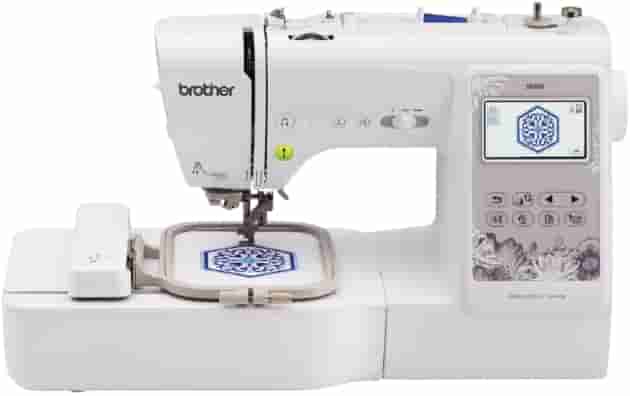
Short on time? If you only take one thing from this guide: Brother SE700 — the machine we point most beginners to — touchscreen, wireless transfer, and it sews as well as embroiders.
Automation in embroidery machines has rapidly evolved, transforming traditional handcraft into highly efficient, tech-driven production. As 2025 unfolds, understanding the most sought-after automation features is essential for embroiderers aiming to optimize operational efficiency and reduce costs.
Current trends indicate a shift toward semi-automatic and fully automatic systems, with the latter offering comprehensive automation that significantly accelerates workflow. These advancements not only improve production speed but also ensure higher precision and consistency, critical factors for small and large embroidery businesses alike.
Top Automation Levels and Features in Modern Embroidery Machines
While semi-automatic embroidery machines require manual intervention during certain steps, fully automatic models like the Brother Entrepreneur Pro X and Janome Memory Craft 14000 incorporate key automation features such as automatic thread cutting, real-time stitch monitoring, and digitization integration. These innovations streamline the entire embroidery process from setup to finishing.
Automatic thread cutting, for example, is highly valued, as it cuts down manual trimming time and reduces waste. Real-time stitch monitoring, often supported by software, helps detect issues proactively, minimizing errors. Digitization integration, such as connecting with dedicated software like Stitch Delight or DecoNetwork, enables quick transfer of designs and facilitates order management, an essential component for scalable operations.
Statistics highlight that approximately 60% of small embroidery businesses are adopting some form of automation. The return on investment (ROI) for these technologies typically becomes evident within 6 to 12 months, primarily through increased productivity and reduced labor costs.
Software Integration and Investment Costs
Popular solutions like Stitch Delight facilitate the digitization of BX fonts, enabling seamless design transfers across various brands, while DecoNetwork helps automate order processing and workflow management. These integrations enhance operational efficiency, making them indispensable tools for modern embroidery setups.
Initial investment costs vary significantly. Entry-level automated machines, such as Brother PE770, start around $600, offering basic automation like automatic thread trimming. High-end commercial models, including JANOME MB-7, can exceed $7, 500 but provide comprehensive automation features suitable for large-scale operations.
Impact of In-the-Hoop (ITH) Automation
In-the-hoop automation technology significantly boosts success rates in completing complex embroidery projects. By automating sequences traditionally done manually, ITH systems have demonstrated up to a 25% increase in finishing efficiency and a reduction in errors, making them vital for intricate designs and high-volume production.
Overall, leveraging automation features such as automatic thread cutting, real-time monitoring, and robust software integration can dramatically enhance embroidery productivity and profitability in 2025 and beyond.
Step-by-Step Guide to Automating Your Embroidery Workflow
Automating your embroidery machine operations can significantly enhance productivity, accuracy, and cost-efficiency. The process involves evaluating your current equipment compatibility, selecting appropriate automation tools, and meticulously integrating them into your workflow. This guide breaks down each step to help you achieve seamless automation for faster, more reliable production.
Evaluate Current Machine Compatibility
Start by assessing your existing embroidery machines, brands like Brother, Bernina, or Janome, and their specifications. Modern models often feature automation-ready capabilities, such as built-in digital interfaces, programmable stitch settings, or compatibility with third-party automation software. Check your machine’s manual or manufacturer website for details on supported automation features and firmware updates that may enhance compatibility. If your current equipment lacks necessary capabilities, consider upgrading to models known for automation integration, such as Janome MB-7 or Brother Entrepreneur series.
Choose and Install Automation Software
Select automation software designed to sync with your embroidery hardware. Options like Stitch Delight or DecoNetwork offer robust tools for pattern digitization, stitch control, and workflow management. Review software specifications to ensure compatibility with your machine brand and model. Once selected, follow step-by-step installation instructions, typically involving downloading setup files, configuring drivers, and linking your device via USB or network connection. Proper configuration allows the software to communicate effectively with your embroidery machine, enabling features such as automatic stitching sequences and real-time monitoring.
Tip: Keep your firmware updated and consult the software user manual for troubleshooting common connection issues.
Install Hardware Accessories for Automation
Enhance your setup with essential accessories like an automatic thread cutter attachment, costing around $200, that reduces manual intervention and speeds up production. Remote monitoring sensors enable real-time oversight of stitch quality and machine status, allowing quick troubleshooting. Digitizing tools such as Wilcom Hatch or EmbroideryOffice help prepare complex patterns optimized for automation, ensuring seamless stitching and minimizing errors. Attach these accessories according to manufacturer guidelines, and calibrate them to match your specific fabric and thread types.
Create Digitized Patterns for Automated Stitching
Design or convert your embroidery motifs using advanced digitizing software like Wilcom Hatch or EmbroideryOffice. Focus on creating files that accommodate automation features, such as jump stitches, tie-offs, and thread trims. Test your designs on similar fabrics, like polyester or metallic threads, to ensure compatibility and quality. Proper digitizing reduces machine downtime and improves pattern accuracy, especially in complex motifs or multi-color designs.
Program and Fine-tune Automated Settings
Configure your embroidery software to automatically adjust stitch density, speed, and thread trimming points based on fabric type and project complexity. For example, settings should be optimized for delicate fabrics like silk versus heavy materials like denim. Use your machine’s interface or the software to set parameters systematically, then run test projects to evaluate stitch quality. Monitor for issues like skipped stitches or thread breaks, and iteratively refine your settings for optimal results.
Tip: Document successful parameter combinations for future reference and streamline your workflow.
Test and Troubleshoot Your Automated Workflow
Begin with small production runs to assess overall performance. Observe stitch quality, consistency, and machine responsiveness. Troubleshoot common problems such as skipped stitches, thread breakage, or misalignments by adjusting stitch tensions, speeds, or digitized pattern placements. Regular maintenance, like cleaning thread paths and updating firmware, ensures your automation setup remains efficient and reliable over time.
By carefully evaluating your equipment, selecting compatible software, and methodically testing your setup, you can achieve a highly automated embroidery workflow that accelerates production and reduces operational costs, positioning your business for sustained growth and success in the evolving craft industry.
Tools, Equipment, and Software for Embroidery Automation
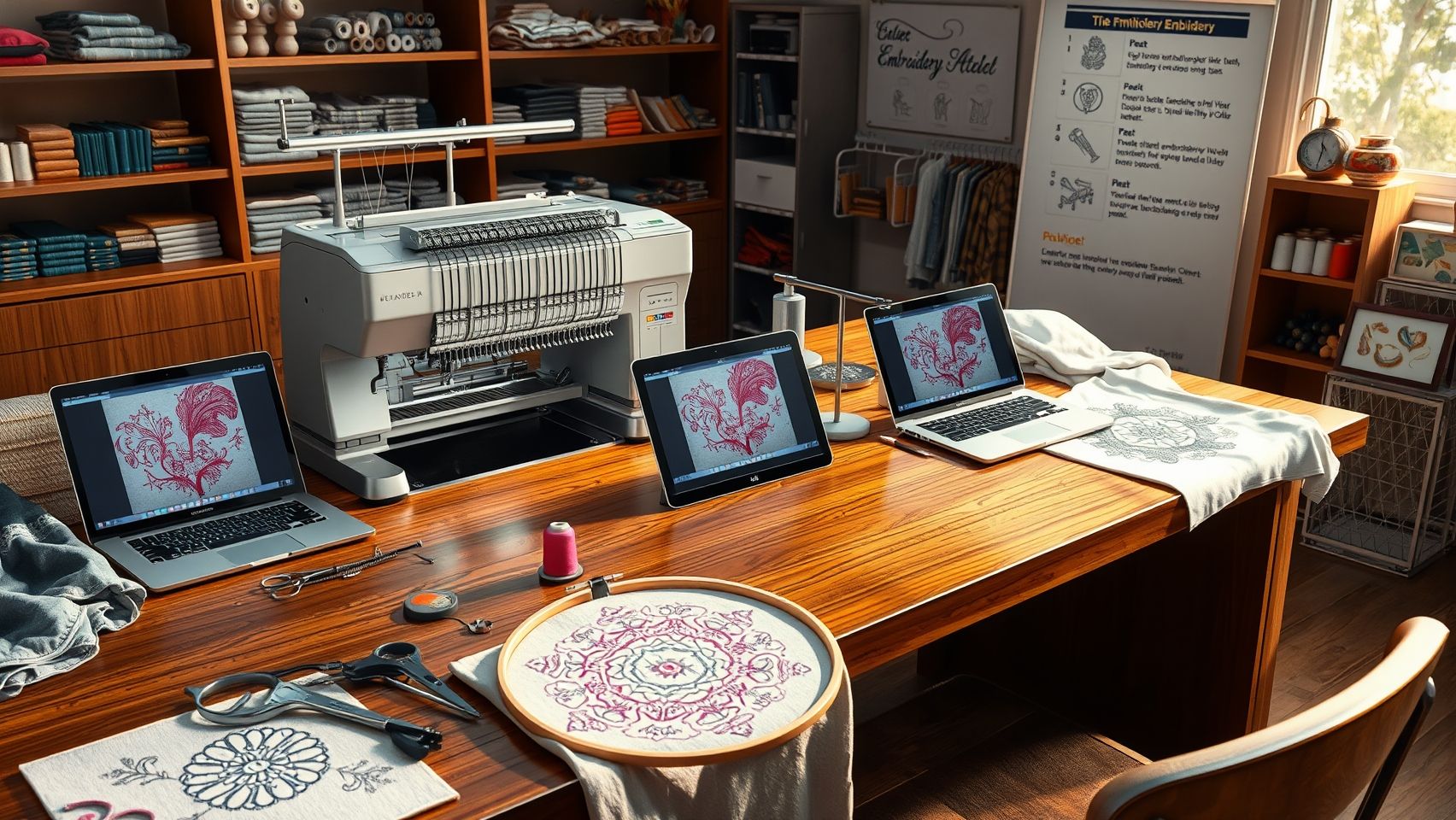
Automation in embroidery machines has revolutionized production efficiency, allowing businesses and hobbyists to create complex designs faster and with greater precision. To achieve seamless integration, selecting the right tools, hardware, and software is essential. This ensures compatibility, maximizes functionality, and reduces downtime, leading to more cost-effective operations.
High-performing embroidery machines with automation capabilities include models like the Brother Entrepreneur X, Janome MB-7, and Bernina Virtuosa 1600E. These models come equipped with features such as automatic thread trimming, multiple needle positions, and large hoop sizes. The Bernina Virtuosa 1600E, priced around $6, 500, is particularly notable for its automatic thread cutters, robust digitizing software compatibility like Wilcom, and advanced automation modules that streamline multi-needle embroidery processes.
Essential Accessories for Automation
To truly leverage automation, certain accessories are indispensable:
- Automatic Thread Cutters: These devices cut threads automatically at the end of each design segment, saving time and reducing manual effort.
- Robotic Arms for Multi-Needle Setups: Priced approximately $1, 200, robotic arms enable multi-needle embroidery machines to switch needles automatically, increasing production speed and consistency.
- Digital Digitizing Tablets: These tablets facilitate design creation and modification directly, supporting software like Wilcom Hatch for pattern digitization and font conversion, thereby enhancing workflow efficiency.
Key Software Options for Automation
Choosing the right software is critical for effective embroidery automation:
- Stitch Delight: Ideal for converting fonts into embroidery files, enabling quick customization and design variations.
- Wilcom Hatch: Industry-leading digitizing software that supports creating intricate patterns, automating the process of converting artwork into embroidery files.
- DecoNetwork: A comprehensive platform for order management, real-time tracking, and client communication, perfectly suited for businesses seeking integrated workflow solutions.
Hardware Requirements for Optimal Performance
Implementing automation requires a robust hardware setup:
- Powerful Computer Systems: High-speed processors and ample RAM are necessary to run complex digitizing and management software smoothly.
- Reliable Internet Connection: Cloud-based software and order management platforms depend on stable internet for real-time data synchronization.
- File Transfer Media: Compatible USB drives or network connections facilitate quick and secure transfer of design files between computers and embroidery machines.
Comparing Features and Setup Tips
When selecting an embroidery machine, consider factors such as the number of needle positions, maximum hoop size, compatibility with automation modules, and overall cost. For example, the Bernina Virtuosa 1600E offers versatile multi-needle setups and large hoops, suited for large-scale production.
Proper calibration, routine maintenance, and keeping software updated are crucial for maintaining machine performance. Regular software updates ensure access to new features and security patches, while calibration aligns design accuracy with physical embroidery results. Establishing a regular maintenance routine minimizes downtime and extends equipment lifespan.
Cost-Benefit Analysis and ROI for Embroidery Automation
Investing in embroidery machine automation can significantly enhance production efficiency and profitability. However, a thorough cost-benefit analysis is essential to ensure a sound financial decision. Small businesses often evaluate initial costs against potential productivity and revenue increases to determine the long-term value of automation projects.
Analyzing Investment Costs
The initial investment typically includes purchasing a mid-range embroidery machine such as the Janome MB-7, which, along with necessary accessories and software licenses like DecoNetwork, totals approximately $5, 000. Additional expenses involve routine maintenance, consumables, and software updates, averaging around $500 annually. For instance, a small business reported that this setup enabled them to handle more orders effectively, with the upfront cost recovered within 12 to 18 months.
Estimating Productivity and Revenue Gains
Automation can halve project completion times, from 8 hours to 4 hours per piece, drastically reducing labor costs. For example, labor savings of roughly $40 per hour translate to an additional $10, 000 per year for a business handling several projects monthly. Businesses offering faster turnaround times and higher-volume orders can also command premium prices, further increasing profit margins.
Case studies indicate that a small enterprise investing $5, 000 in automation technology experienced a 45% increase in monthly output within six months, alongside a doubling of productivity. Such results demonstrate the substantial return on investment achievable with strategic automation deployment.
Break-Even Point and Long-Term Profitability
Most small businesses reach their break-even point within the first 12 to 18 months, as savings on labor and increased order capacity outweigh initial costs. ROI metrics from recent industry reports reveal that investments in advanced embroidery machines, like the Janome MB-7 paired with modern digitizing software, yield a rapid payback period, often under a year, while significantly boosting long-term profitability.
In summary, a well-planned automation investment not only accelerates production but also enhances profit margins through higher output and premium offerings. Evaluating initial costs against realistic productivity gains and revenue increases ensures sustainable growth in a competitive craft industry.
Conclusion

Embarking on the journey to automate your embroidery workflow can dramatically enhance productivity, reduce costs, and elevate the quality of your finished products. The key lies in carefully selecting the right automation tools that align with your current setup and business goals. Remember to follow step-by-step setup procedures to ensure smooth integration and optimal performance. Additionally, analyzing the return on investment (ROI), by tracking efficiency gains, labor savings, and quality improvements, will help you make informed decisions and justify further investments.
Begin with small projects to build confidence and understand the nuances of automation, then gradually scale up as you see measurable results. Don’t let hesitation hold you back, today’s industry trends indicate that embracing automation is not just a competitive edge but a necessity for sustainable growth. Take actionable steps now to transform your embroidery process, unlock new opportunities, and stay ahead in a rapidly evolving market. Your future success starts with the decision to innovate today, start small, think big, and achieve greatness.