What Is Punch Needle? A Clear Explanation
Punch needle is a technique that uses a hollow needle to push loops of yarn or thread through fabric, rather than stitching in and out of it. You hold the tool like a pen, punch it straight down until it stops, lift it just to the surface, and slide across to the next spot. Each punch leaves a loop behind on the far side of the fabric. Nothing is knotted and nothing is tied off. The loops stay put because the fabric grips the yarn.
That single difference is what makes punch needle so much faster than ordinary embroidery. You are not pulling a full length of thread through the fabric on every stitch, so filling a large area takes minutes instead of hours.
How it differs from ordinary embroidery
In hand embroidery the needle carries the thread through the fabric and back out, and the stitch is finished on the surface you are looking at. In punch needle the tool never leaves the fabric in the same way. It goes down, deposits a loop underneath, and comes back up only far enough to move along.
The practical consequences are worth knowing before you start:
- You usually work from the back. If you want the looped side to be the finished face, you punch from the reverse, which means your design must be traced mirrored. Text especially catches people out.
- There are two right sides. The loop side is textured and rug-like. The flat side is a neat row of what looks like backstitch. Both are legitimate finishes, and you choose before you begin.
- Nothing is secured with knots. Loops hold by friction alone, which is why fabric choice and tension matter far more here than in regular embroidery.
Why the fabric matters more than the tool
This is where most first attempts fail. The weave has to be open enough for the needle to pass without cutting threads, but tight enough to grip the yarn once it is in. Too loose and your loops fall out the moment you take the work off the frame. Too dense and the needle will not penetrate cleanly.
Match the cloth to the scale you are working at:
- Monk’s cloth for rug punch with heavy yarn. Its loose, even weave is built for it.
- Weaver’s cloth for fine punch with embroidery floss. A cotton and polyester blend that grips small loops well.
- Not quilting cotton. It is too tightly woven for the needle and too smooth to hold loops.
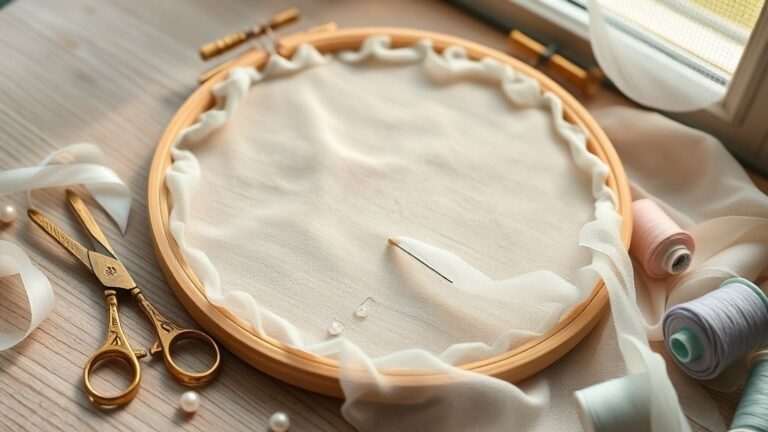
The fabric also has to be drum-tight. Not hoop-tight, drum-tight. A gripper frame with carpet tacks holds tension far better than a standard embroidery hoop, and slack fabric is the single most common reason loops pull out.
The two scales of punch needle
People often talk about punch needle as one craft, but the two ends of it barely share equipment.
Rug punch uses a large needle and heavy yarn on monk’s cloth to make cushions, wall hangings and rugs. The Oxford punch needle is the best known tool here. Progress is fast and the results are chunky.
Fine or embroidery punch uses a small adjustable needle and standard embroidery floss on weaver’s cloth. This is the one used for hoop art, patches and detailed illustrative work. The needle depth is adjustable, which sets the loop height.
Buying the wrong scale for the project you have in mind is the other common early mistake. A rug needle will not make fine detail, and a fine needle will not take rug yarn.
Is it hard to learn?
The motion itself takes about ten minutes to get right. Punch down until the needle stops against the fabric, lift only to the surface, slide, punch again. The mistake nearly everyone makes at first is lifting the needle too high between punches, which pulls the previous loop back out.
What takes longer is judgement: spacing your rows so the loops sit shoulder to shoulder without crowding, keeping tension even, and learning how a design reads once it is filled. That is a few projects, not a few months. Compared with learning to digitize or to hand embroider well, punch needle is genuinely quick to pick up.
Frequently Asked Questions
What is punch needle?
Punch needle is an embroidery technique that uses a hollow needle to push loops of yarn or thread through a stretched fabric, leaving a loop on the far side with each punch. It is worked without knots, and the loops are held in place by the tension of the weave rather than by being tied off.
Is punch needle the same as rug hooking?
No, though the results can look similar. Rug hooking uses a hook to pull loops up through the fabric from below. Punch needle pushes loops down through it from above. Punch needle is considerably faster; rug hooking gives you more control over each individual loop.
Do the loops fall out?
Not if the fabric is right and the tension is right. Loops are held by friction, so they only pull out when the weave is too open, the fabric was not drum-tight, or the needle was lifted too far between punches. Finished pieces that will get handled are often backed with fabric glue or a fused lining for security.
What fabric do you use for punch needle?
Monk’s cloth for rug punch with heavy yarn, and weaver’s cloth for fine punch with embroidery floss. Avoid quilting cotton, which is too tightly woven for the needle to pass cleanly and too smooth to hold the loops.
Do you punch from the front or the back?
You punch from whichever side is not your finished face. If you want the looped, textured side to show, punch from the back and trace your design mirrored. If you want the flat stitched side to show, punch from the front.
Can you use a punch needle on any fabric?
No. The weave has to be open enough to let the needle through without cutting threads, and tight enough to grip the yarn afterwards. That balance rules out most standard dressmaking and quilting fabrics.
Ready to choose a tool? See which punch needle needles work best.